
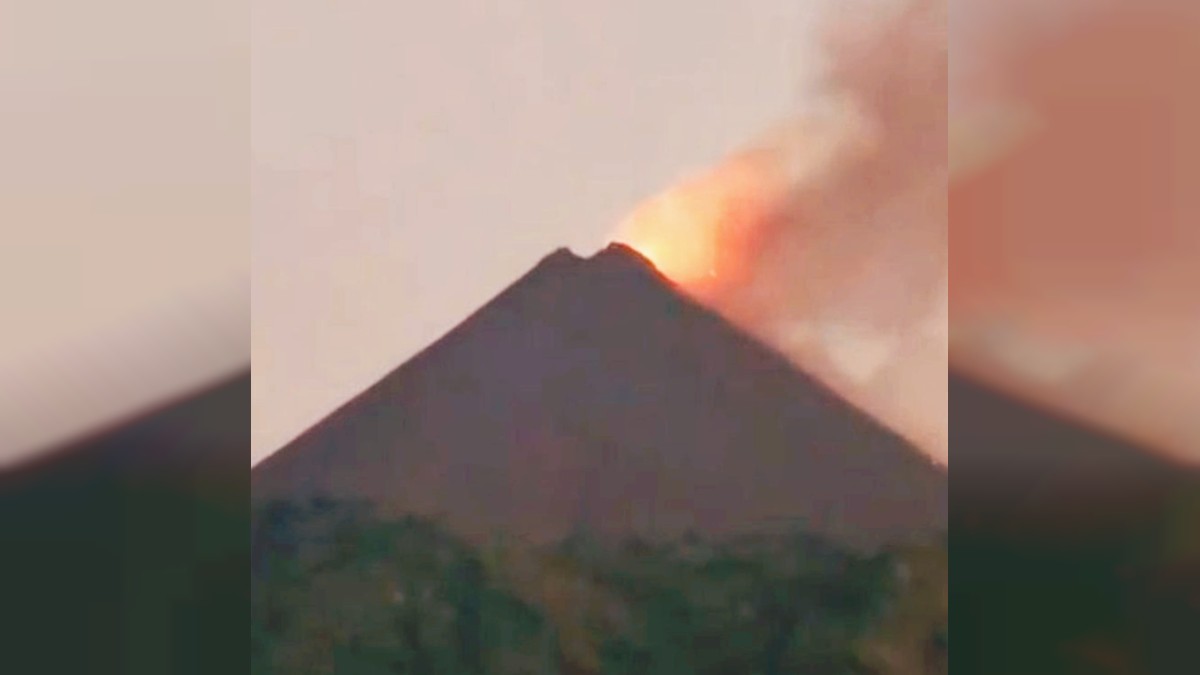
Port Blair Sept 3: A fiery glow pierced the night sky over the Andaman Sea last month when an Indian Navy warship, patrolling the waters near the remote Barren Island, caught sight of molten lava and ash shooting into the sky. This was no ordinary spectacle. Within eight days, the volcano — India’s only active one — erupted twice, sending ripples of concern across the region and reminding us that deep below the serene turquoise waters, the Earth’s restless heart is still beating.
The fresh episodes of volcanic activity were reported in September 2025, with officials confirming the events on September 22. Barren Island, a small uninhabited landmass of just 8.34 sq km, lies about 120 km northeast of Port Blair. Its nearest inhabited neighbors — Swaraj Dweep (Havelock) and Narcondam Island — are between 90 and 120 km away, far enough to be safe yet close enough to keep watch. This eruption marks yet another chapter in the island’s dramatic history. The volcano’s first recorded eruption dates back to 1789, when British officer Lieutenant Archibald Blair — after whom Port Blair is named — documented violent activity. For decades, the island appeared dormant, but science later revealed that it had never truly slept. Significant eruptions occurred in 1991, 2005, 2017, 2022, and now again in 2025. Thanks to advancements in marine geology, particularly with the Geological Survey of India’s Samudra Manthan vessel in the 1980s, much of the volcano’s hidden history was uncovered, showing that Barren Island has remained sporadically active for centuries.
A wider pattern of unrest: The recent Barren Island eruption came just days after a powerful earthquake struck the Philippines earlier this week, leaving scores dead and buildings flattened. Scientists say these two events, though separated by hundreds of miles, share a common cause — the movement of the Earth’s tectonic plates.
Barren Island sits on the volatile junction of the Indian and Burmese (Myanmar) plates, part of the massive “Ring of Fire” — a horseshoe-shaped belt of seismic activity encircling the Pacific Ocean. The Philippines, too, lies along this fiery zone. Here, immense geological forces push and grind the plates against each other, triggering earthquakes, volcanic eruptions, and tsunamis. “Both the Philippines quake and Barren Island’s eruption are products of subduction — where one tectonic plate is forced under another,” explained a senior geologist. “The friction and pressure generated over years, even centuries, get released suddenly, often violently.”
Nature’s reminder: While the Barren Island eruption has so far caused no damage to nearby islands, it is a stark reminder that the Andaman and Nicobar archipelago remains one of India’s most seismically active regions. The islands have faced frequent tremors due to their proximity to major fault lines, and experts warn that such events highlight the need for constant monitoring.
The Indian Navy, Coast Guard, and local administration continue to keep a close watch on the volcano’s activity, while scientists urge preparedness for any unforeseen natural hazards in the region. The resurgence of Barren Island, juxtaposed with the devastation in the Philippines, serves as a compelling testament to our planet’s dynamic nature — a world where beneath calm seas and lush islands lie immense forces that shape life and land alike.(Story based on the inputs from Dr Amlanjyoti Kar, Scientist/Hydrologist)