
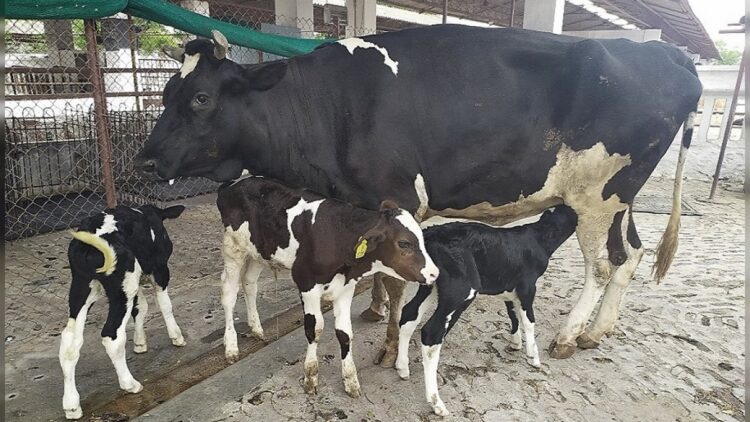
Port Blair: The Andaman & Nicobar Islands have taken a major leap towards scientific dairy farming, with advanced reproductive technology showing promising results that could transform livestock productivity and boost milk production across the Union Territory. In a landmark achievement, the Department of Animal Husbandry and Veterinary Services (AH&VS), Andaman & Nicobar Administration, in collaboration with the National Dairy Development Board (NDDB), Anand, Gujarat, has successfully implemented the ambitious Embryo Transfer Technology (ETT) programme in the Islands — a move expected to usher in a new era of genetic improvement in cattle breeding. Under the programme, four phases of embryo transfer procedures were successfully carried out during 2026 across different parts of the Islands.
Altogether, 78 embryo transfers were performed on carefully selected recipient cattle. According to official reports, the first phase was conducted on February 10 and 11 with 20 embryo transfers, followed by the second phase on March 13 and 14 with another 20 transfers. The third phase on April 16 and 17 recorded 19 transfers, while the fourth phase held on May 19 and 20 also completed 19 transfers successfully. The initiative has already yielded encouraging results, with pregnancy diagnosis confirming 20 recipient animals as pregnant so far. Officials stated that further confirmations are expected in the coming weeks as follow-up examinations for the remaining cattle continue.
The Embryo Transfer Technology programme aims to rapidly improve the genetic quality of cattle by producing superior progeny from elite donor animals. Experts believe the technology can significantly enhance milk productivity in the Islands, where dairy farming remains an important livelihood activity for many rural families. Officials said female calves born through the programme are expected to produce nearly 15 litres of milk per day during their first lactation — substantially higher than the present average milk yield in the Islands.The programme is also expected to strengthen the dairy sector by increasing milk production, improving livestock quality and enhancing the income of farmers through scientific breeding practices.
Authorities described the success of the project as a major demonstration of how advanced reproductive technologies can be effectively implemented even under the challenging conditions of island territories.
Senior officers of the AH&VS Department expressed satisfaction over the progress achieved and appreciated the dedicated efforts of veterinarians, para-veterinary staff and supporting personnel involved in the execution of the programme. The Department also acknowledged the crucial technical support and training provided by the National Dairy Development Board (NDDB), Anand, throughout the implementation process.
Reaffirming its commitment to modernising livestock development, the Department stated that more advanced reproductive technologies, including Sex Sorted Semen and other scientific interventions, would be expanded in the coming years to promote sustainable and profitable dairy farming across the Andaman & Nicobar Islands.